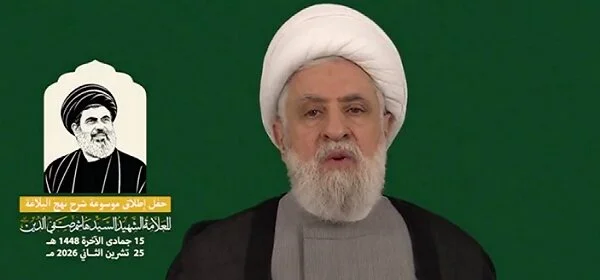
Hezbollah chief Qassem says group will defend its existence, criticizes Lebanon's president
Hezbollah Secretary-General Sheikh Naim Qassem said the group will defend its existence and rights, criticized President Joseph Aoun's Independence Day speech, and praised Iran's support in a Wednesday speech in Beirut.
Published on 25 November 2026
SaveHezbollah chief Qassem says group will defend its existence, criticizes Lebanon's president
Hezbollah Secretary-General Sheikh Naim Qassem said on Wednesday that the group would defend its existence and rights, and criticized Lebanon's president over his Independence Day remarks, in a speech delivered at the launch of an encyclopedia titled "Explanation of Nahj al-Balagha" by the late Sayyed Hashem Safieddine.
Qassem said Hezbollah had accepted the Taif Agreement and the Taif Constitution as a socio-political contract for all Lebanese, describing the Constitution as the frame of reference that unites the country. He quoted the constitutional provision that the President of the Republic is the head of state and the symbol of the nation's unity, and said the presidency carries a unifying and responsible mission. He argued that President Joseph Aoun's Independence Day speech, which he said equated what he called Israeli-American aggression with the Lebanese Resistance, was misplaced and had drawn wide controversy. Qassem asked whether the president should stand by his people rather than steer toward removing enmity with the Israeli enemy, and said those who care about Lebanon's unity, independence and sovereignty had described the speech as inappropriate.
Qassem said the only danger in Lebanon is the Israeli enemy, which he said occupies land and persists in aggression, and described the Resistance as a reaction to that problem, existing because the state and army lack the capabilities to confront the enemy. He said the Resistance fills a gap and performs a duty for which the state was primarily responsible. He cited costs borne over two years, including more than 10,000 martyrs among fighters, men, women, children and civilians, 30,000 wounded, the destruction of hundreds of thousands of homes and prisoners. He said Hezbollah seeks no thanks from anyone and considers its reward with God, and recalled that Sayyed Hassan Nasrallah had stressed keenness to protect other Lebanese components even at higher cost.
On sovereignty, Qassem listed five points: halting the aggression, Israeli withdrawal and deployment of the Lebanese Army south of the Litani River, the release of prisoners, reconstruction of destroyed villages, and the return of residents to normal life. He said there is no sovereignty without liberation and no independence under what he called American tutelage, and criticized pressure on Lebanese authorities for concessions in favor of Israel. He said the authorities implemented the ceasefire of 27 November 2024 while Israel did not, and called on the state to file complaints with the Security Council and to equip the army from the state budget, rejecting aid conditioned on internal strife. He said any new international resolution must fall under Resolution 1701 and the November 2024 agreement, rejecting any replacement with the Framework Agreement, and said any international force outside the UN umbrella would be considered an occupying force.
Qassem praised Iran, saying Hezbollah is proud of its relationship with the Islamic Republic, which he said halted Israeli aggression against Lebanon within its current bounds and ties its agreement with America to halting aggression on all fronts. He said "Iran, thank you until our last breath," and referred to the leadership of Ayatollah Sayyed Mojtaba. He also said the group would capitalize on what he described as defeats suffered by Trump in congressional elections and by Netanyahu in Israeli elections, and called for the release of young men detained in Batroun, saying the Dahr al-Baidar detainees were Resistance youth in a normal situation. He affirmed that the door to internal understanding remains open and that Hezbollah supports civil peace and the army's role.
On the book launch, Qassem described Sayyed Hashem Safieddine as an extension of a scholarly lineage including Sheikh Ragheb, Sayyed Abbas, Sayyed Hassan Nasrallah, Imam Khomeini, Imam Khamenei and Imam Musa al-Sadr. He said the commentary, produced since 2011 with scholars Sheikh Khalil Rizk, Sayyed Ali Abbas al-Mousawi and Sayyed Ali Abdul-Mun'im Murtada under Safieddine's chairmanship, reflects the centrality of Imam Ali (a.s.) and Nahj al-Balagha, including its teachings on piety, justice and the financial policy of Imam Ali (a.s.). According to Al-Manar English Website, as cited by Mehr News, Qassem made the remarks at the Wednesday ceremony.
Source: Mehr News — Read original story